
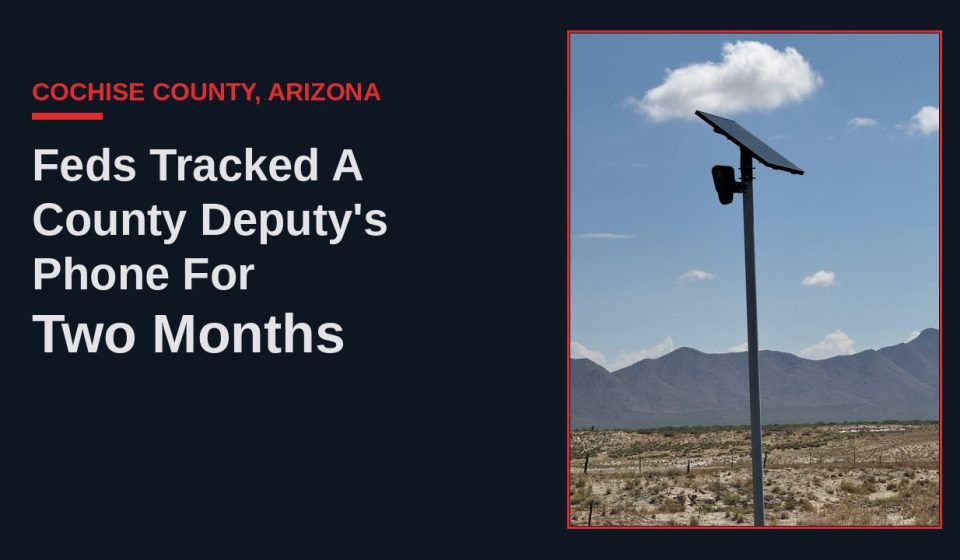

For two months this summer, federal agents held legal authority to track the personal cellphone of a Cochise County sheriff’s deputy — and a judge signed off on every day of it. Court documents show the Drug Enforcement Administration obtained a search warrant for GPS location tracking and a cell tower simulator, the kind of surveillance normally aimed at major trafficking organizations. No charges have been filed. The deputy has not been named.
What the court documents say
Reporting by Terri Jo Neff of the Eastern Arizona Courier and Herald/Review, published August 14, laid out what the warrant file contains:
July 17 — the warrant. Judge Anne Borowiec of Cochise County Superior Court signed a DEA search warrant targeting the cellphone of an unnamed Cochise County Sheriff’s Office deputy. The authorization covers 60 days of GPS location tracking plus the use of a cell tower simulator — a stingray device that sweeps up data from every phone nearby, not only the target’s. A 60-day window starting in mid-July runs into mid-September.
The case behind it. The warrant was issued as part of a federal investigation into what the documents describe as a large-scale drug trafficking organization. One detail stands out: the DEA agent working the case is dual-sworn with the Cochise County Sheriff’s Office — the very agency whose deputy was the target.
April — the sworn statements. Two fellow deputies gave sworn written statements saying they believed the deputy was selling cocaine, both on duty and off.
April — the citizen report. A citizen separately reported the deputy driving while impaired, describing the deputy as being under the influence of a substance other than alcohol — and claiming the deputy purportedly offered the citizen some of that substance.
A stingray aimed at one phone
A cell tower simulator doesn’t sort its targets. Deployed to follow one deputy’s phone, it sweeps up data from every device in range — neighbors, passersby, anyone else on the road that day — all pulled into a federal net built around a single unnamed officer of the law. And the paperwork authorizing it spans two full months, signed by a county judge, before any charge existed.
A county that has seen this before
The DEA file doesn’t sit alone on Cochise County’s recent record. The county’s top prosecutor took a DUI plea deal. The prosecutor’s chief deputy admitted tampering with evidence. Now one of the Sheriff’s Office’s own deputies has spent a summer under federal phone surveillance, suspected — on paper, so far only suspected — of moving cocaine while wearing a badge.
What happens next
As of the latest reporting, the deputy remains unnamed and uncharged, and the file rests on a single local newsroom’s review of the court records — which is exactly why this account sticks to what those documents say. The surveillance window runs into mid-September, meaning the operation may still be active. Every claim is an allegation, and the unnamed deputy is presumed innocent unless and until proven guilty — the same standard the badge represents. This post will be updated the moment charges, a name, or a Sheriff’s Office response surfaces.
Two months of federal tracking were approved before anyone was charged — so who signs off on watching the watchers?
Sources
Terri Jo Neff — Eastern Arizona Courier / Herald/Review (eacourier.com, myheraldreview.com) · Cochise County Superior Court warrant records, per court documents obtained by local reporting
☕ Support this desk — buy us a coffee · tips fund records requests and server time



Every story like this starts the same way: someone typed a name, a plate, an address — and the databases already had it. Yours does too. Optery shows you exactly which sites are selling your personal info and scrubs you off them automatically. Free scan, paid plans do the removal. We earn a commission if you sign up — it costs you nothing extra.