
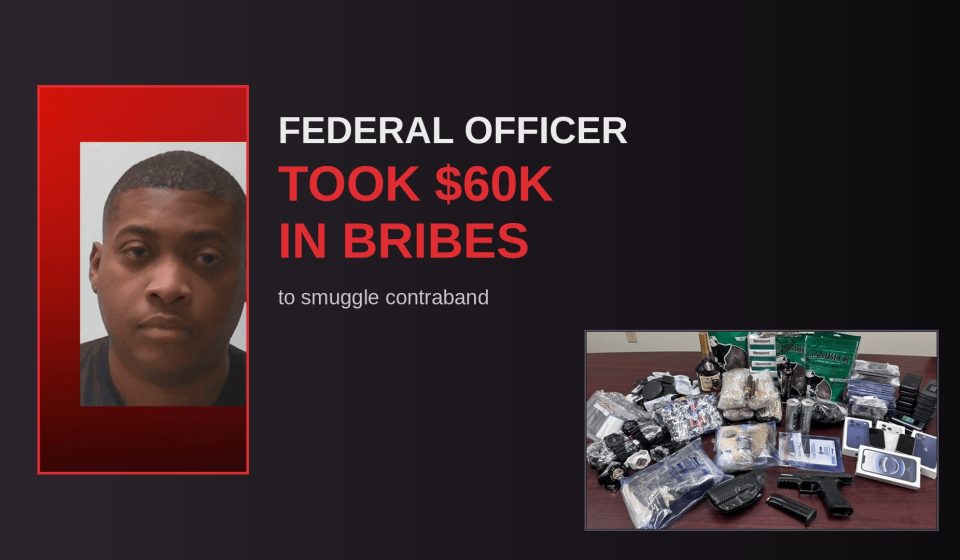
Federal Officer Took $60K In Bribes To Smuggle Contraband Into Prison

The seizure log said “confiscated.” The federal indictment says the correctional officer who signed it was the smuggler.
Joseph Templeton, 30, a correctional officer at FCI Bennettsville — a Federal Bureau of Prisons facility in Marlboro County, South Carolina — has been indicted by a federal grand jury in Florence on bribery, money laundering, and marijuana possession with intent to distribute. Prosecutors say he took more than $60,000 in bribes to smuggle contraband into the prison, and then did something that turns this case from ordinary to remarkable: he processed the contraband as official seizures before distributing it inside.
The scheme, as charged
According to the indictment announced by the U.S. Attorney’s Office for the District of South Carolina, Templeton accepted the bribes from an inmate and associates of the inmate. In exchange, he brought in cellphones, cellphone accessories, cigarettes, and THC products.
The alleged concealment method is the part prison investigators will be studying. Rather than slipping contraband past the facility’s controls, Templeton is accused of using them — recording the items as confiscated contraband in official paperwork, making them disappear onto the books, and then distributing them inside the facility anyway. The seizure log, the system designed to catch smugglers, allegedly became the smuggling tool.
He’d been caught before
This wasn’t a first offense. The Marlboro County Sheriff’s Office previously arrested Templeton after investigators said they found more than $100,000 worth of contraband and narcotics in his possession — a state case charging possession with intent to distribute marijuana and bringing contraband into a facility. The federal indictment landed while that case was still pending.
The investigation
The case was built by the Department of Justice Office of the Inspector General, the FBI’s Columbia field office, and the Marlboro County Sheriff’s Office — the same sheriff’s office whose earlier arrest had flagged him. The announced maximum exposure across the federal counts is 20 years in prison.
What happens next
Templeton awaits prosecution in federal court in the District of South Carolina, Florence division, with the parallel state charges still hanging. No plea has been entered, and no arraignment date has been publicly reported. This post will be updated as the case develops: plea, trial schedule, and whether other employees are implicated.
Every charge is an allegation right now. Templeton is presumed innocent unless and until proven guilty.
A $60,000 trail of phones, smoke, and paperwork that said “seized” — in a facility where one officer’s signature was the control system. How many seizure logs get a second look now?
Sources
DOJ / U.S. Attorney’s Office, District of South Carolina · WMBF (Gray TV) · Marlboro County Sheriff’s Office
☕ Support this desk — buy us a coffee · tips fund records requests and server time
The ledger entry that cracked it
The twist that separates this case from every ordinary smuggling ring: the contraband went through the front door as paperwork. Rather than risking the search checkpoints with items hidden on his body, prosecutors say Templeton took the bribes, brought in cellphones, accessories, cigarettes and THC products — and then processed them as official seizures, generating the facility’s own documentation for goods that were never actually confiscated. On paper, a model officer intercepting contraband. In the evidence room, the same items waiting to move inside. The system designed to prove compliance became the method of evading it, and the indictment’s money-laundering count shows investigators followed the $60,000 backward through the accounts that received it.
That is why federal prosecutors charged this as bribery plus laundering plus possession-with-intent instead of a simple contraband introduction case. Each count attacks one layer: the payments, the cleaning of the money, the goods themselves. A jury that believes any one layer convicts on it.
The economics no one wants to say out loud
Sixty thousand dollars is the number to hold up against the paycheck. A federal correctional officer with a few years in earns roughly the high-five figures — annually. Prosecutors are alleging the inmate economy paid this officer multiples of his salary, which is the honest accounting the Bureau of Prisons keeps avoiding: as long as contraband inside sells at several times street price, the wage an officer earns is the subsidy a smuggling operation counts on. Phones are the real product — an incarcerated man paying for a phone is paying to keep his operation, his threats and his business alive from inside — and cigarettes and THC are the volume trade that keeps the courier valuable between big orders.
The season of the crooked wall
This case did not land alone. It anchors a corrections file this desk keeps having to build: a Florida sergeant charged in an inmate drug operation with her boyfriend, four guards at one Arkansas facility splitting $205,563 in bribes, a prison system’s own investigator charged over his own camera searches. Three states, three agencies, one design flaw: the person paid to be the wall is the first one getting quoted a price.
Templeton is presumed innocent; the charges are allegations and can be amended as the case moves toward trial. This story will be updated.




Every story like this starts the same way: someone typed a name, a plate, an address — and the databases already had it. Yours does too. Optery shows you exactly which sites are selling your personal info and scrubs you off them automatically. Free scan, paid plans do the removal. We earn a commission if you sign up — it costs you nothing extra.