
Watch the video:
A North Carolina detention officer is accused of forging magistrates’ signatures on court orders — twenty times — so the jail could hold immigrants beyond their release dates without anyone in a robe ever seeing them.
Michael Shaun Diehl Jr., 40, an eighteen-year veteran of the Guilford County detention staff, is charged with 20 counts of felony common law forgery. He was fired during the investigation and released on a $5,000 secured bond. Sheriff Danny Rogers says additional charges may be coming as the case develops.
How the scheme surfaced
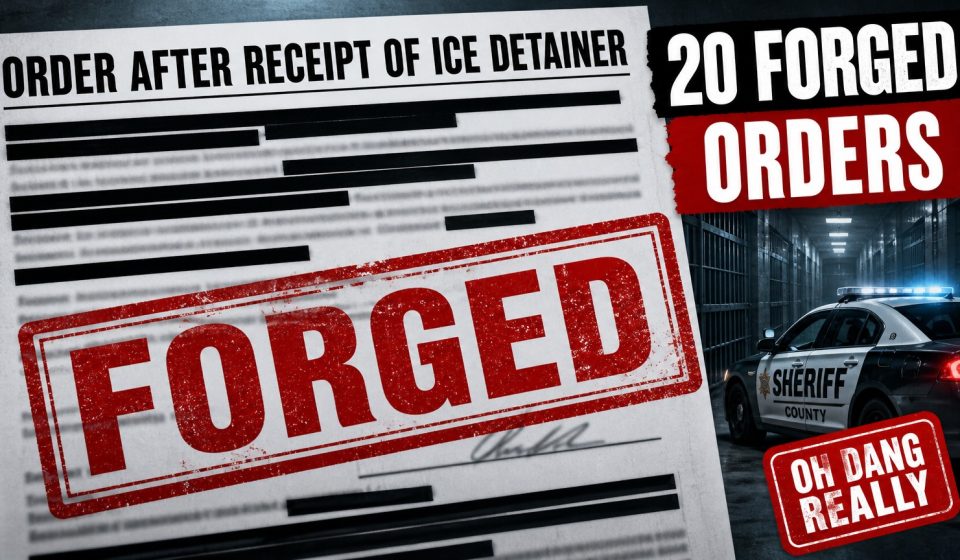
It started with one inmate and one form. On September 11, 2026, just after 8:00 a.m., the Guilford County Magistrate’s Office notified the sheriff’s office about a suspicious document — an order authorizing the jail to keep an ICE-detained inmate locked up for up to 48 extra hours past his release date. The form, an AOC-CR-662, is supposed to follow a specific ritual: the inmate must be brought before a magistrate, handed a copy of the federal detainer, and a magistrate must personally review the request before signing.
That inmate was Claudio Nepornuceno. Investigators say he was never presented to any magistrate. Instead, the form carried the forged signature of a magistrate who had no involvement in his booking at all.
When the magistrate’s office caught the first fake, detectives went through the booking records behind it — and found nineteen more forged orders tied to nineteen more inmates. Twenty in total, all following the same pattern: no magistrate review, no presentation, just a signature that was never real, entered on a form that was supposed to trigger a judge’s look.
Why the magistrate step exists at all
The 48-hour hold is where federal immigration enforcement leans directly on local jails. Under North Carolina law — G.S. 162-62(b1) — a jail may hold someone who has completed their state case when ICE files a detainer, but only with a magistrate’s sign-off. The design is deliberate: the agency that wants the extra custody is not the one that gets to authorize it. A neutral magistrate reviews the paperwork, sees the inmate, and decides.
Forging the signature removes exactly that check. It turns a judicial decision into jailhouse paperwork — one officer self-certifying, twenty times, on a form whose entire purpose is to prevent one officer from self-certifying. Prosecutors charged each forged form as its own felony, so the count isn’t symbolism: it is one count per signature.
The detail the sheriff made a point of
One nuance in the sheriff’s statement matters more than it first appears: in all twenty cases, ICE had actually issued a detainer based on suspected immigration violations. That means the holds may have been legally obtainable — if the paperwork had gone through a magistrate, as the law requires. Investigators are not alleging Diehl invented the detainers. They are alleging he skipped the only step that made the detainers lawful to act on.
That distinction is the whole case. The form exists to force a second pair of eyes; the accusation is that the second pair of eyes was cut out because it slowed the process down. Twenty inmates, twenty forged signatures, zero reviews.
What happens to the twenty cases now
Every one of those holds was carried out under a signature that did not exist. Defense attorneys for the twenty inmates now have a document trail showing their clients’ extra days in custody rested on forgeries — and the jail’s own records are the proof. Motions to suppress the holds, civil claims over unlawful extension of custody, and a review of every detainer case the jail processed during Diehl’s shift patterns are the obvious next dominos. The sheriff’s office has not said how far back the review will reach, only that it is continuing.
The accountability ledger
Diehl had been with the sheriff’s office since June 2008 — eighteen years on the custody side of the building, the side nobody films, where the paperwork is the process. His arrest lands in a month that has already produced four guards at one Arkansas federal prison caught in a $205,563 bribery scheme, a Texas prison sergeant booked on a family violence charge, and a CIA officer caught hiding millions in gold behind a fake spy program. What ties the file together is not the conduct — it is how long each scheme ran before anyone looked at the paper.
Diehl has not entered a plea, and the investigation is active. Each forgery count is a felony, and the sheriff has left the door open to more charges — which, with twenty documented forms and nineteen additional inmates already named in the review, is a door with a crowd behind it.
Anyone charged with a crime is presumed innocent, and a charge is not evidence of guilt. Charges can be amended, enhanced or dropped as a case moves through the courts. This story will be updated as the case develops.
☕ Support this desk — buy us a coffee · tips fund records requests and server time