
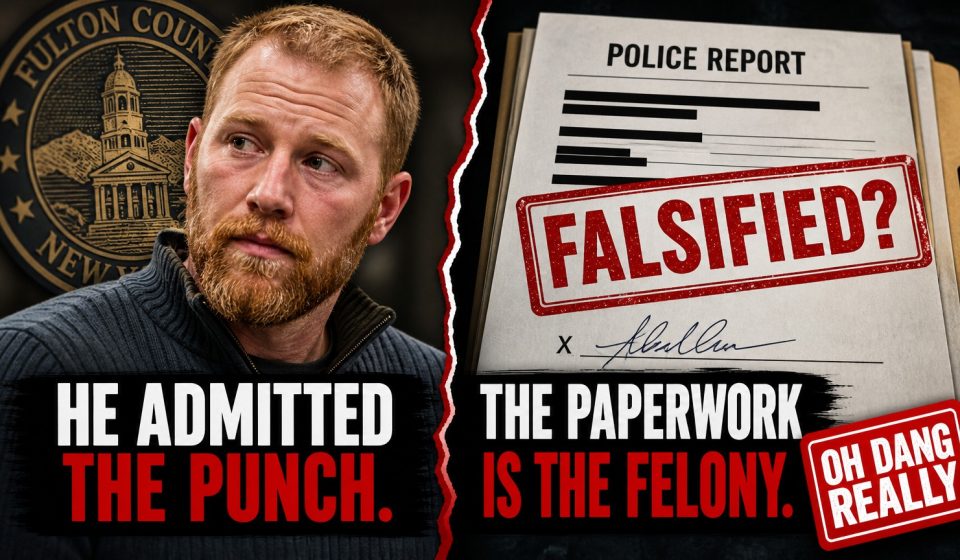
Gloversville Cpl. Ryan Hernigle Charged With Felony Falsifying Records After Off-Duty Punch

Watch the video:
A Gloversville, New York police corporal admitted throwing one punch during an off-duty fight outside his own jiu-jitsu studio. What he is actually charged with now is the paperwork.
Cpl. Ryan Hernigle, an eight-year veteran of the department, faces a felony falsifying-business-records charge plus official misconduct after the July 31 incident — and the reason is simple: police say the report he generated didn’t match what happened, and what happened included him admitting he struck a man once. The twist that makes the case genuinely strange: Hernigle is also an elected Fulton County supervisor, sitting on the county legislature’s public safety committee. The man who writes county oversight policy now has his own oversight question to answer.
The fight outside the studio
According to investigators, the other man in the fight had thrown a brick at Hernigle’s truck, causing thousands of dollars in damage. That is the provocation — and it’s the part his defenders keep pointing to. What followed is the part prosecutors care about: the corporal confronted him, threw a single punch, and admitted doing so. Then came the report. Police say the official account didn’t line up with the admissions, and the discrepancy between what an officer knows and what an officer writes is exactly what falsifying-business-records was written to reach.
The outcomes have already split in a way people notice. The man who threw the brick is held without bail. Hernigle — the one charged with a felony — went home on paid leave.
The provocation problem
Every criminal case has a sympathy ledger, and this one is unusually lopsided. The man who threw the brick caused thousands in damage to a truck — conduct that, aimed at anyone else, would make Hernigle the victim of a straightforward vandalism case. Prosecutors have not disputed the brick. What they charge instead is the gap between what an officer admitted and what he wrote, because a police report is not a diary — it is the document every other part of the system leans on. Bail decisions, protective orders, insurance claims and plea offers all inherit whatever the report says. A report that bends, even after a provocation, poisons everything built on top of it.
That is also why the charge pairing matters. Official misconduct alleges he used his position — the badge and the report-writing authority that come with it — in a way the law forbids. Falsifying-business-records alleges the document itself was corrupted. Together they cover both the act and the authority, which is why the district attorney’s office reached for both instead of letting the punch stand as a simple misdemeanor altercation.
A committee seat that votes on public safety
Sitting on a public safety committee means voting on the budgets and policies of the very system now processing his case. Fulton County’s structure makes the overlap unavoidable: the county funds the district attorney, the jail and emergency services, while Gloversville runs its own police department. An elected supervisor charged with falsifying records while employed as a corporal creates conflicts no recusal fully cures — colleagues vote on contracts with a department that is simultaneously investigating his conduct and paying his leave.
The optics compound the legal exposure. A public safety committee member whose own report is the subject of a falsifying charge is, functionally, the story of every accountability debate in one person: who watches the people who write the reports? His fellow supervisors have said nothing publicly, and no removal mechanism short of conviction or voter recall applies to a county legislator in New York between elections.
It also lands in a month crowded with paper-trail prosecutions: a North Carolina detention officer accused of forging magistrates’ signatures twenty times, an Oakland case where test flights existed only on forms. The pattern keeps repeating: in accountability cases, the violence is the headline, but the paperwork is the charge that sticks.
What happens next
His first court appearance was expected within days of the charge. It slid a month — to October 14, 2026, in Gloversville City Court. That hearing is where the defense lays out its theory of the report: sloppy, incomplete, or falsified with intent — the difference between a defense verdict and a felony record. A falsifying-business-records conviction is a Class E felony, the lightest felony class in New York, but a conviction carries consequences that outlast any sentence: loss of police certification, loss of the county seat, and a permanent answer to the fitness question every department dreads.
Hernigle has not entered a plea, and neither the department nor the county has said whether his committee seat or his leave status will change before the October hearing. This story will be updated as the case develops.
Anyone charged with a crime is presumed innocent, and a charge is not evidence of guilt. Charges can be amended, reduced or dropped as a case moves through the courts.
☕ Support this desk — buy us a coffee · tips fund records requests and server time